

Reviewed by IMPS Editorial Team · Last reviewed
Manageable revision, protected routines, practiced calming skills, and timely support can ease board exam stress in the final month. The aim is workable preparation, not the removal of every nervous feeling. Small, clear steps give students somewhere to start.
A student may switch between unfinished chapters and classmates’ progress updates without settling into either. Pressure from school, home, and personal goals can feed fear of disappointing others. Uncertain results and peer comparison can affect focus and mood.
Waiting to feel completely ready can delay useful work. A single corrected answer offers a clearer goal than judging the whole syllabus. The next achievable task deserves attention before the next comparison.
Key Takeaways
- Choose small tasks with clear stopping points.
- Leave room to correct mistakes.
- Protect meals, rest, and movement.
- Practice calming skills before worry peaks.
- Seek support when daily life becomes difficult.
A 30-Day Revision Plan for Board Exam Stress
Solving five quadratic-equation questions and correcting errors gives a checkable target; “finish mathematics” does not. A useful timetable includes review, correction, and spare capacity, not just new chapters. Board exam stress management works best when the daily load leaves room for all three.
A useful timetable includes review, correction, and spare capacity, not just new chapters.
The roadmap below is an adjustable example, not a board timetable or a promise to finish every syllabus. School commitments and the order of exams may change the sequence. Each progress check helps guide the next day’s work.
| Days Remaining | Main Task | Practice Task | Progress Check |
|---|---|---|---|
| 30-22 | Map topics and repair key gaps | Attempt a short diagnostic question set | Identify three priority gaps |
| 21-15 | Revisit priority topics | Complete timed sections | Record recurring errors |
| 14-8 | Consolidate covered topics | Attempt a timed paper when feasible | Review errors and pacing |
| 7-1 | Refresh concise notes and corrected errors | Use selected questions from weak areas | Confirm the next paper’s priorities |
Choose Priorities From the Syllabus and Exam Order
Students can sort topics into secure, shaky, and not yet covered using the actual syllabus. Exam order and teacher guidance help decide what needs attention first. A brief question set can reveal gaps that familiar-looking notes hide.
A secure topic needs a light check rather than another full reading. A shaky topic needs focused practice on the step that keeps going wrong. An uncovered topic may need a teacher’s explanation before solo work makes sense.
CBSE means the Central Board of Secondary Education. NCERT means the National Council of Educational Research and Training. CBSE learners should use relevant NCERT textbooks and applicable official sample papers; other boards require their prescribed materials.
Active recall means retrieving information from memory before checking notes or an answer key. Closing a book and explaining a process shows what learning has stayed available. Checking afterward reveals what needs repair, without treating a gap as failure.
Build a Daily Loop of Recall, Practice, and Correction
A daily loop can start with 25 minutes of closed-book recall, followed by a 5-minute break. Another 25 minutes of questions can lead into a short correction session. These blocks illustrate a sequence, not a universal study-hour target.
An error log records practice mistakes and their corrections. For a wrong quadratic answer, it might note a sign error and the corrected line. Revisit missed questions on a later day without looking at the worked answer first.
Practice papers help rehearse question formats and pacing, while shorter sets can target one weak skill. Leave a buffer for a slow topic or an unexpected school task. A missed block calls for changing priorities, not doubling tomorrow’s workload.
Progress means noticing which errors no longer recur, not filling every empty space in the plan. A smaller completed task can provide better feedback than several rushed chapters. A sustainable timetable also protects places for meals, rest, and movement.
Protect Sleep, Meals, and Movement
An extra tired hour at the desk may offer less usable attention than a rested study session. Time spent sitting with books does not measure the quality of learning. Daily habits protect health and help the body recover between demanding tasks.
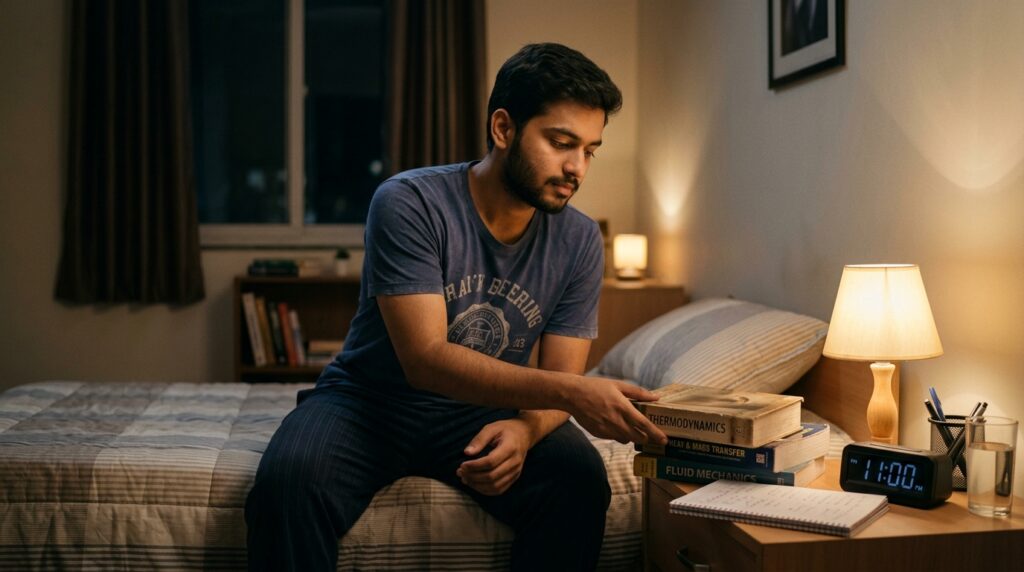
Keep Sleep Consistent Instead of Extending the Night
Teenagers generally need 8-10 hours of sleep per night. A steady bedtime and waking time help protect that space during preparation. A quiet wind-down period can mark the end of work without another round of questions.
Insufficient rest can worsen concentration, memory, and the ability to manage feelings. Repeated late-night catch-up sessions make a poor trade when they cut into needed hours. The extra reading may come at the cost of attention the following morning.
A difficult night calls for a gentler next day, not self-criticism. Lighter tasks may fit better than a demanding practice paper when tiredness is high. Returning to the usual routine matters more than trying to force an ideal night.
Make Food, Movement, and Breaks Easy to Maintain
Regular meals, drinking water, and physical activity support well-being during revision. Keeping these habits simple makes them easier to maintain when attention feels stretched. Parents can help by keeping familiar options within reach rather than changing everything at once.
- Keep a familiar meal or snack available.
- Keep drinking water accessible.
- Take a short walk or stretch between sessions.
- Schedule one enjoyable nonacademic activity.
A walk of about 15 minutes can provide a change of scene. That example does not replace a full day’s need for movement. Music, drawing, or talking about something unrelated to marks can also create a genuine pause.
Rest need not wait until every task is complete. Preparation chats and scrolling may make poor breaks when they deepen comparison. A useful pause should leave less mental noise, rather than another list of classmates’ achievements.
Before an exam, sleep, a familiar meal, water, and brief review of familiar cues can support readiness. No food or last-minute trick guarantees better recall. Even with these habits, a sudden wave of worry may need a practiced response.
Quick Calming Techniques for Racing Thoughts
A student may reread the same line while imagining a disappointing result. Gentle breathing, sensory grounding, and balanced self-talk offer a small reset during exam stress. These optional practices are tools to try, not tests to pass.
Grounding shifts attention toward the immediate surroundings when the mind races ahead. A balanced statement links fear to a practical action rather than a sweeping prediction. The techniques below may help some teenagers regain focus before returning to work.
| Technique | How to Try It | Useful Moment | Adjustment |
|---|---|---|---|
| Gentle breathing | Take comfortable breaths with a slightly longer exhale for about one minute | Feeling keyed up before starting work | Return to ordinary breathing if dizzy or uncomfortable |
| Sensory grounding | Notice five things visible, four things felt, and three things heard | Attention caught in racing thoughts | Use fewer observations if counting feels distracting |
| Balanced self-talk | Replace “Everything is ruined” with “One question is difficult; the next step is manageable” | A mistake triggers a spiral | Choose believable wording rather than forced positivity |
Practice on ordinary days makes a chosen response more familiar before exams. No method works for everyone, and discomfort is a reason to adjust or stop. These skills can sit alongside anxiety counseling, rather than replace care suited to individual needs.
Worry about an unfinished topic can become one clear question for a teacher. That action gives uncertainty somewhere useful to go instead of feeding another hour of peer comparison. The goal is to return to a workable step, even if some tension remains.
A qualitative study of test anxiety interviewed 22 medical students at one Saudi medical school. Some described using routines, social support, professional help, or exercise to cope. These findings concern medical training, not Indian school students.
A practiced response gives students something familiar to use when worry interrupts exam preparation. They can pause without demanding complete calm before making a decision. That pause can support practical choices just before the paper and while answering questions.
The Final 30 Minutes and the Exam Hall
Checking the venue and materials the previous evening reduces avoidable uncertainty before board exams. The final stretch works best with familiar cues, not a new chapter. The school’s reporting instructions and the paper’s rules take priority over any general checklist.
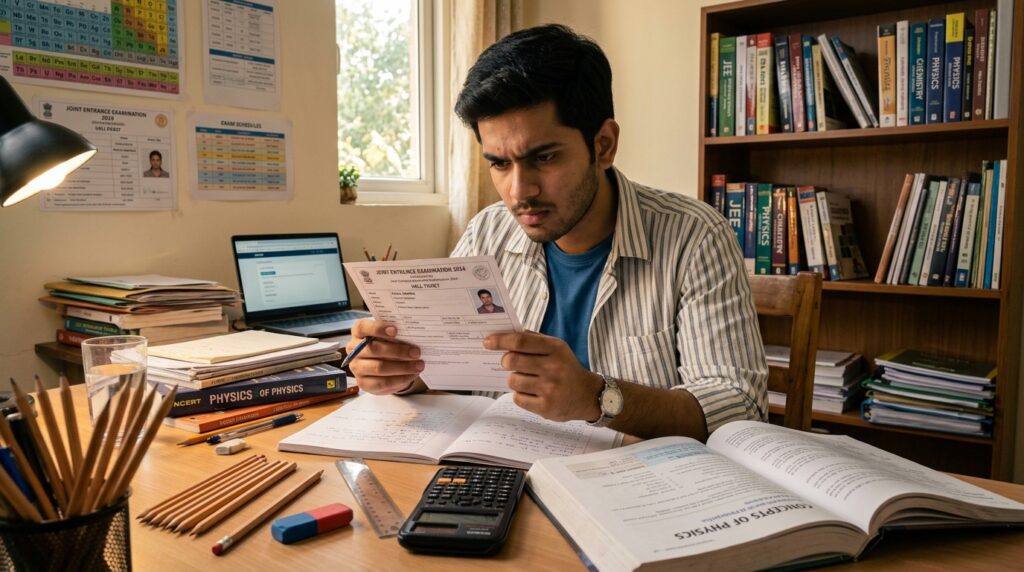
A simple schedule can separate practical preparation from last-minute revision. Travel plans need room for ordinary delays, without treating every possible problem as likely. Parents can help with transport details while leaving space for a quiet start.
- Verify the admit card, allowed stationery, venue, and reporting instructions the previous evening.
- Arrange travel with a reasonable buffer.
- Use the final 30 minutes for settling and familiar cues, rather than a new chapter.
- Read instructions and distribute writing time by marks.
- Take a short recovery break before planning the next paper.
For a hypothetical paper, 180 minutes of writing time minus 15 minutes for checking leaves 165 minutes. On an 80-mark paper, that allows about 2 minutes per mark. Mandatory sections, reading time, and individual question demands can change this rough guide.
If a student blanks, a brief pause can interrupt the rush to predict poor results. They can identify the command word and note one relevant cue. Moving to another permitted question may help before returning to the difficult one.
Students needing disability-related support should ask their school about applicable arrangements as early as possible. Approval depends on the school and examining body’s rules and may need advance planning. They should not assume staff can approve changes at the venue.
Afterward, optional answer debates may prolong stress without changing the submitted paper. Skipping those discussions leaves more room to recover before preparing for later exams. Persistent distress needs human support, not just a better exam technique.
When Parents, Teachers, or a Counselor Should Step In
Distress that disrupts eating, sleeping, attendance, or ordinary activities deserves attention. Students need not wait until exams end to seek human support. The impact on daily life matters more than finding a diagnostic label alone.
Distress that disrupts eating, sleeping, attendance, or ordinary activities deserves attention.
Offer Practical Help Without Adding Pressure
Parents and teachers can offer one calm daily check-in and listen before suggesting solutions. Praise for specific effort, such as correcting a recurring mistake, is clearer than broad demands to work harder. Comparisons with siblings or classmates add pressure without identifying a useful next step.
A quieter place to work can matter more than another reminder about marks. A student might ask a trusted teacher to help explain unrealistic expectations at home. That conversation can turn a repeated argument into an agreed, manageable workload.
Friends can offer company and shared practice without becoming scoreboards. A parent can ask whether listening or practical guidance would help most that day. The answer may change as the next paper approaches.
Seek Professional Care When Daily Life Is Disrupted
Temporary exam-linked worry often eases after exams, but intense, persistent, or disabling symptoms deserve assessment. Duration alone does not establish a diagnosis. Repeated panic, marked sleep or appetite changes, withdrawal, school avoidance, and hopelessness warrant attention.
Board exam stress treatment may involve counseling or cognitive behavioral therapy after assessment. This therapy helps address unhelpful thought and behavior patterns. An appropriately qualified clinician decides whether medication has a role for an adolescent.
A trusted adult, school counselor, or doctor can help arrange qualified mental health care. Fear of social judgment beyond exams may also need assessment. Social anxiety treatment addresses a distinct concern, not a label for every assessment-related worry.
Thoughts of self-harm call for immediate adult and professional support. In India, Tele-MANAS provides mental health support at 14416. Immediate danger calls for emergency services at 112 or the nearest emergency department.
A trusted adult should stay present when safe during an immediate crisis. Asking for help is compatible with serious preparation, including when a smaller workload becomes necessary. Care should not wait until the results arrive.
Conclusion
One difficult day does not determine the remaining month. Earlier learning still counts when a plan slips or a practice paper goes badly. Steadiness matters more than a perfect streak of completed tasks.
Some students need a smaller workload, more explanation, or another person’s support. Those needs do not signal a lack of effort. A realistic starting point leaves room to work with today’s limits rather than fight them.
Preparation can be adjusted as needs change. Marks describe an academic outcome, not a person’s worth or the whole of their future. The next concrete step is to write down tomorrow’s first achievable task.